
How Google’s latest app turns ideas into imagery—and what it means for creators, teams, and product builders
In September 2025, Google introduced Mixboard, a new AI-powered mood-board app built to help users “brainstorm, design, and visualize ideas” via generative technology. Because of this release, the creative-collaboration space has been quietly shaken. The app is currently in public beta within the U.S. via Google Labs. The Times of India
What Was Announced
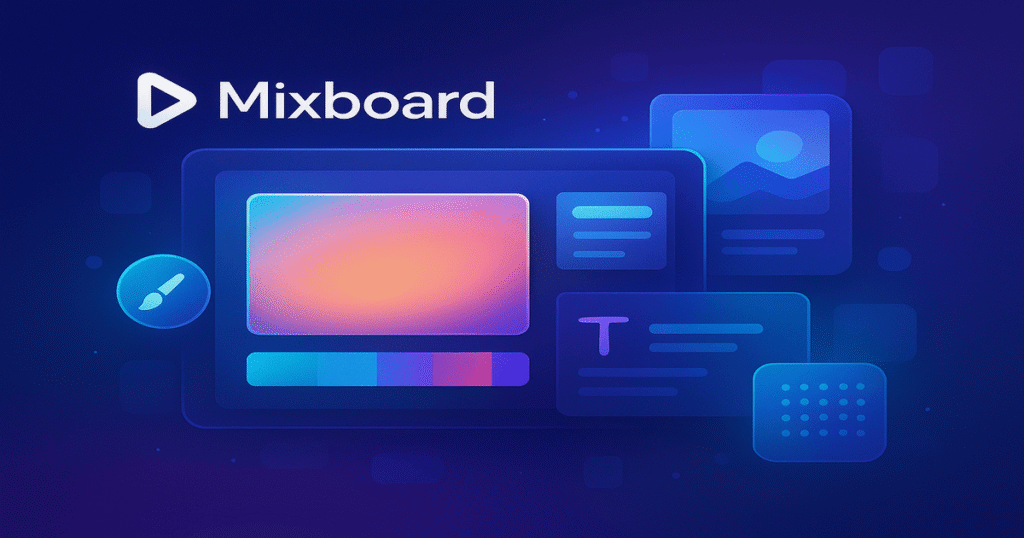
Mixboard was described by Google as an app designed to accelerate ideation by combining generative AI with visual layout tools. It is positioned as a competitor to platforms such as Pinterest, but with deeper AI integration. The Times of India
Key highlights include:
- Users can input text prompts, existing images or even sketches — and receive AI-generated mood boards that reflect style, theme and layout.
- An early community via Discord has been established so that early adopters can share ideas, feedback and suggestions. The Times of India
- The app is currently limited to U.S. users in public beta; global rollout appears planned but not yet detailed.
Because this product was launched in a niche (creative visual ideation) rather than just editing or sharing, it signals a subtle shift: AI isn’t just editing visuals—it’s helping generate creative frameworks from scratch.
How Mixboard Works
While full technical specs have not been published, several features are inferred:
- A generative model that interprets prompts + optional visual inputs, then outputs a board (“mini-canvas”) composed of images, colour palettes, textures, typography and layout suggestions.
- The user is given editable elements, not just a locked image—so the mood board becomes a starting point rather than an endpoint.
- The AI is integrated into a collaborative design workflow: teams can share, comment, iterate on boards within the app environment.
- Because the app is in beta, it is likely instrumented for feedback loops: user preferences, board refinements and usage patterns will guide future updates.
In effect, Mixboard is leveraging generative AI to shift from “make a design” → “make a design direction”.
Sample Code Snippet: Conceptual Integration
Here is a simplified pseudocode snippet illustrating how a developer might call a generative-mood-board API to embed similar capability in a desktop or web-app context:
|
1 2 3 4 5 6 7 8 9 10 11 12 13 14 15 16 17 18 19 20 21 22 23 24 25 26 27 28 29 30 31 |
# Pseudocode: Generate a mood-board via API import requests API_KEY = “YOUR_API_KEY” ENDPOINT = “https://api.mixboard.google.com/v1/generate_board” def create_mood_board(prompt: str, reference_images: list = None, style: str = “modern_minimal”): payload = { “prompt”: prompt, “references”: reference_images or [], “style”: style, “editable”: True, # indicates output will allow further edits “collaboration”: {“enabled”: True} } headers = { “Authorization”: f“Bearer {API_KEY}”, “Content-Type”: “application/json” } resp = requests.post(ENDPOINT, json=payload, headers=headers) resp.raise_for_status() return resp.json() # e.g., {“board_id”: “…”, “elements”: […], “share_url”: “…”} # Example usage result = create_mood_board( “Mood board for summer home interior: light wood, pastel green accents, Scandinavian feel”, reference_images=[“image1.jpg”,“image2.jpg”] ) print(“Board created:”, result[“board_id”], “Share URL:”, result[“share_url”]) |
While not the official API (which may differ), this snippet provides a structural view of how generative boards could be requested and integrated.
Why It Matters for Developers and Product Teams
This launch is important for several reasons:
- Democratising ideation: By generating not just visuals, but creative frameworks, Mixboard reduces friction between idea and execution.
- Workflow integration: For teams working on design, marketing, branding, having a tool that scaffolds an idea into actionable visuals can speed up iteration.
- New monetisation paths: If mood-boards become collaborative, editable assets, platforms could monetise via premium templates, team seats, brand-kits.
- Product differentiation: As visual tools become saturated, offering “idea-to-layout” generative AI becomes a differentiator rather than standard editing.
- Relevance to your interests: Given your focus on productivity, community-building, and AI apps, Mixboard provides a case study in building apps where users generate ideas together, not just consume content.
Challenges & Considerations
Despite the promise, several caveats are worth noting:
- The app is still in beta and has limited access (U.S. only) — global adoption may change UX or value proposition.
- Generative mood boards may raise copyright/training-data concerns, especially if reference images incorporate brand or licensed material.
- Collaboration features may add complexity: versioning, editing conflicts, brand compliance need thoughtful handling.
- As with all creative-AI tools, the “output” might still require human curation or editing—so expectations must be managed.
- Monetising early may depend on building a community around board-sharing, templates, and user-generated assets.
Key Takeaways
- Google’s Mixboard is an early entrant in the generative-AI mood board space, enabling ideation flows rather than just editing.
- Developers building within creative, productivity or community-based apps should consider including features that generate editable frameworks for users.
- Workflow support (sharing, editing, collaborating) is key to sustaining engagement beyond initial novelty.
- While the visual trend is strong, product success will rely on usable value, not just “cool generative outcomes”.
FAQ
Mixboard is Google’s new AI-powered mood board app, designed to help users brainstorm and visualize ideas through generative imagery and layout tools. The Times of India
Currently it is a public beta available in the U.S., via Google Labs. Wider rollout is yet to be detailed. The Times of India
Yes—it appears built for ideation and collaboration, which suggests brand workflows, team boards and editable output are part of its use-case.
If you build a productivity or community-app, consider embedding generative pre-layouts, shareable templates, and team collaboration tools. The key is idea-to-action rather than remix-only.
Conclusion
Mixboard’s launch may not dominate headlines yet, but it signals a deeper shift in visual-creation tools: from editors to co-creative spaces. Because users increasingly expect tools to help them generate ideas and collaborate around them, product teams that build these flows early may gain a meaningful edge.
Latest trending app product launches




Leave a Reply