

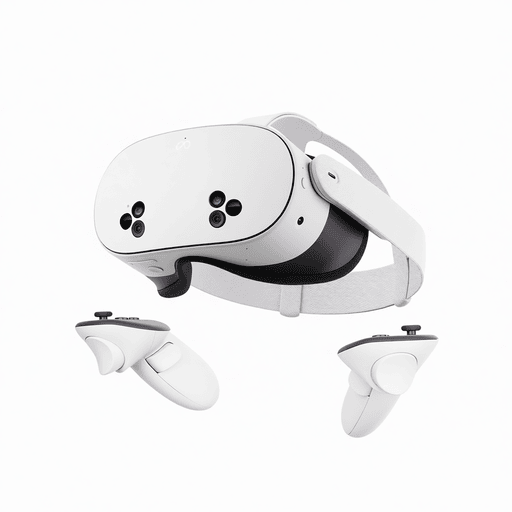
The Meta Quest 3S 256 GB is a standalone virtual reality (VR) / mixed-reality (MR) headset developed by Meta’s Reality Labs. Unlike PC-tethered headsets, it operates wirelessly — meaning you can play, exercise, and explore immersive worlds without being physically connected to a computer. Thanks to its powerful hardware, ample storage, and optimized design, the 3S is positioned as a more affordable yet capable alternative to Meta’s higher-end Quest devices.
Key Features & Capabilities
Here is a breakdown of the core “about this item” features, with deeper insight into what they mean and how they work in practice:
1. No Wires, More Fun (Wireless Freedom)
- The Quest 3S is untethered, which means no cables are restricting your movement. This freedom allows for more physically active play: you can dodge, duck, and move around as you would in real life.
- Because it’s all-in-one, you don’t need a high-end PC or external tracking stations, which simplifies setup and makes it ideal for more casual or mobile VR use.
2. 2× Graphical Processing Power
- The device is powered by the Qualcomm Snapdragon XR2 Gen 2 chipset. This is a significant upgrade over older Quest models, delivering about twice the graphical processing power compared to more dated hardware. Tom’s Hardware+2PC Guide+2
- This boost in GPU capability translates into smoother frame rates, richer textures, and overall more visually complex and responsive VR experiences.
3. Experience Virtual Reality (Mixed Reality Support)
- The 3S supports mixed reality through its dual RGB color passthrough cameras. These cameras capture your real environment in color, allowing virtual content to be overlaid realistically. Wikipedia
- Moreover, there is a dedicated action / passthrough button that makes switching between full VR and mixed reality quick and intuitive. Reviewers note that this improves the usability when you want to glance at your surroundings. Android Central
- Hand tracking is also supported, enabling you to use your hands (without controllers) in compatible apps. PC Guide
4. 2+ Hours of Battery Life
- The headset is equipped with a 4,324 mAh battery. According to specs, this gives roughly 2.5 hours of typical use. Tom’s Hardware+1
- Usage time will vary depending on what you’re doing: lighter use (like menus or video viewing) may last longer, but more graphically intensive games can reduce runtime. As one reviewer observed, demanding titles may only yield around 2 hours. Android Central
- Importantly, you can play while charging via USB-C, making it possible to extend sessions with a power bank or compatible charging dock. Gadget Connect
5. 33% More Memory – 8 GB RAM
- The Quest 3S has 8 GB of RAM, which is about 33% more than some earlier Meta headsets. Alezay+1
- This memory upgrade helps in running more demanding games and MR apps by improving responsiveness, reducing stutter, and allowing more complex scenes to load smoothly.
6. Dual RGB Color Cameras
- Two high-fidelity RGB (color) cameras are included, enabling realistic passthrough for mixed-reality experiences. Wikipedia
- These cameras are used for both environment mapping and hand tracking, and their color video feed makes MR content more believable. TechRadar
- The passthrough fidelity is rated at 4 MP per camera with good pixel density, which supports accurate spatial placement of virtual objects. PC Guide
7. Instant Access to 40+ Games
- When you purchase a Quest, you often receive a 3-month trial of Meta Quest+ (formerly Horizon+), which grants access to a rotating catalog of 40+ games. Alezay
- This makes it easy for new users to dive into a variety of VR experiences right away, without needing to commit to buying many titles.
Technical Specs & Design Details
To better understand how the 3S is built and what it can do, here’s a more detailed look at its hardware and physical design:
- Display & Optics
- Resolution: 1,832 × 1,920 pixels per eye for crisp visuals. Tom’s Hardware
- Refresh Rate: Supports 72 Hz, 90 Hz, and up to 120 Hz for fluid motion. Unbound XR
- Optics: Uses Fresnel lenses, which help reduce cost but can produce some “god-ray” effects. TechRadar
- IPD (Inter-Pupillary Distance): Adjustable with three discrete settings (e.g., 58 mm / 63 mm / 68 mm). Tom’s Hardware
- Performance & Memory
- System-on-chip (SoC): Qualcomm Snapdragon XR2 Gen 2, optimized for VR and MR workloads. Wikipedia
- RAM: 8 GB LPDDR, which supports multitasking and more complex scenes. Wikipedia
- Storage: Options for 128 GB or 256 GB. You chose the 256 GB version, which offers plenty of space for large VR libraries. Alezay
- Weight & Build
- Weight: ~514 grams according to multiple sources. Android Central+1
- Strap: Comes with a soft adjustable strap; a more rigid or battery-equipped strap is sold separately. Unbound XR
- Glasses support: Includes a glasses spacer, making the headset more comfortable for users with eyeglasses. Alezay
- Tracking & Controllers
- The headset supports 6-degrees-of-freedom (6DoF) tracking for both the headset and the controllers. Tom’s Hardware
- Controllers: Uses Touch Plus controllers, which provide precise tracking and comfortable grip. Alezay
- Haptics: Features TruTouch variable haptics, making interactions more immersive by varying vibration intensity. Mizzo Shopping
- Connectivity
- Wi-Fi 6E: For fast downloads, multiplayer, and smooth streaming. Gadget Connect
- Bluetooth 5.2: Connect accessories or communicate with other devices. Tom’s Hardware
- USB-C port: For charging, data, and potentially for streaming or linking to a PC. Gadget Connect
- Battery
Strengths & Advantages
Why the Meta Quest 3S 256 GB is a strong choice, based on its features and user feedback:
- Generous Storage: With 256 GB, there is a lot of space for large games, MR content, and media. This reduces the need to constantly uninstall/reinstall apps.
- High Performance: The Snapdragon XR2 Gen 2 delivers a big performance boost, enabling smoother visuals and more demanding games.
- Mixed Reality Capability: The dual RGB passthrough cameras enable a credible MR experience, and the action button simplifies switching between real and virtual worlds.
- Comfortable & Lightweight: At ~514g, the headset is relatively light, and the adjustable strap helps distribute weight.
- Long Enough Sessions: 2.5 hours of battery life is decent for most casual gaming, working, or entertainment sessions.
- Instant Game Access: The trial for 40+ games lets new users explore different titles without an immediate large investment.
- Value: Considering its feature set, the 3S offers a cost-effective entry to powerful VR/MR without needing a gaming PC.
Trade-offs & Drawbacks
However, there are some trade-offs and limitations you should be aware of:
- Display & Visual Fidelity: Because the 3S uses Fresnel lenses instead of pancake lenses, some users note edge distortion, “god rays,” or less clarity compared to higher-end headsets. TechRadar
- Fixed IPD Settings: With only three discrete IPD settings (instead of a continuous slider), some users may struggle to find the perfect eye alignment, which can affect clarity. TechRadar
- Battery Limitations: While 2.5 hours is good for many, more intensive VR games will drain faster; continuous, long sessions may require a battery pack or docking. AG4Tech
- Passthrough Quality: Although the color passthrough is a big plus, it’s not perfect — some reviewers and users say it’s not as sharp or clear as real vision. WIRED+1
- Comfort Strap: The default strap is soft but may not be ideal for extended high-movement sessions; many users recommend upgrading to a better strap for long-term comfort. Android Central
- No 512GB Option: For users who want extremely large VR / MR libraries, there’s no 512 GB model for the 3S (unlike some other high-end headsets), so very heavy users might find even 256 GB limiting. TechRadar
User Feedback & Real-World Use
User reviews and community commentary help paint a realistic picture of how the 3S performs:
- A user on Reddit said: “I was able to test the tracking … even if the controllers are behind your back … the tracking continues … That’s more than enough …”
- Regarding battery and charging, another noted: “The resulting battery life … depends … on what you are playing. … I was able to use a power bank … or buy an Elite Strap …”
- On mixed reality and passthrough: “Thanks to the … passthrough cameras … we can see our real environment … This also allows us to play mixed reality games … In a well-lit environment … the image is more usable.”
- On upgrading from older Quest: “It is a HUGE upgrade to the 2 … the new hardware makes the games look less blurry and faster … just some glare … but that is okay … you won’t regret it.” Reddit
Critics also point out that, while it’s very good for its price, it’s not as “premium” as the Meta Quest 3:
- TechRadar notes that the 3S has lower resolution per eye and narrower field of view than the Quest 3. TechRadar
- Tom’s Hardware highlights that the use of Fresnel lenses (instead of pancake lenses) is a cost trade-off: “This tradeoff … had to be made to hit a lower price point.” Tom’s Hardware
Ideal Use Cases: Who Should Use It
Given its strengths and trade-offs, the Meta Quest 3S 256 GB is particularly suited for:
- Casual and Intermediate Gamers
People who want a powerful, wireless VR experience without investing in a tethered PC setup. - Newcomers to VR / MR
Those who are entering the virtual reality space and want a capable, but not overly expensive, headset. - Mixed Reality Enthusiasts
Users interested in overlaying digital content on the real world — for creative tools, MR games, or productivity. - Media Consumers & Social Gamers
Thanks to the large storage, you can store lots of games or media, and access to 40+ games via Quest+ makes it easy to dive in. - On-the-Go or Portable VR Use
Because it’s self-contained and has a good battery life, it’s ideal for portable gaming or travel (though you’ll need to plan charging for long sessions).
Conclusion & Final Thoughts
To sum up, the Meta Quest 3S 256 GB is a very attractive option in today’s VR market. It offers a strong mix of performance, memory, and mixed-reality capability — all while staying untethered and relatively affordable. The 256 GB storage is a big plus, giving users the freedom to keep many apps, games, and content installed without worrying about space.
That said, it’s not without compromises. The display isn’t as high-resolution as the top-tier models, the lenses are Fresnel (which may introduce some optical artifacts), and the battery life, while decent, isn’t meant for marathon sessions unless you use an external power solution.
If you are looking for value, flexibility, and an accessible entry point into mixed reality, the Quest 3S 256 GB is definitely a smart choice. On the other hand, if absolute visual fidelity, advanced lens tech, or ultra-high storage capacity is your top priority, you might consider looking at higher-end models or future devices.





Leave a Reply