
How the Viral AI Image-Editing Trend Is Changing the Future of Digital Creativity
In 2025, the world of artificial intelligence apps has taken another unexpected turn. Google Gemini, Google’s flagship AI platform, has rocketed to the top of global app-store charts thanks to its latest viral feature — Nano Banana. This creative AI function allows users to generate hyper-realistic, emotionally driven image edits with just a few words. Because of its simple yet striking results, it has reshaped how users interact with AI, transforming casual curiosity into daily creative expression.
The Viral Wave: What Made Google Gemini Trend
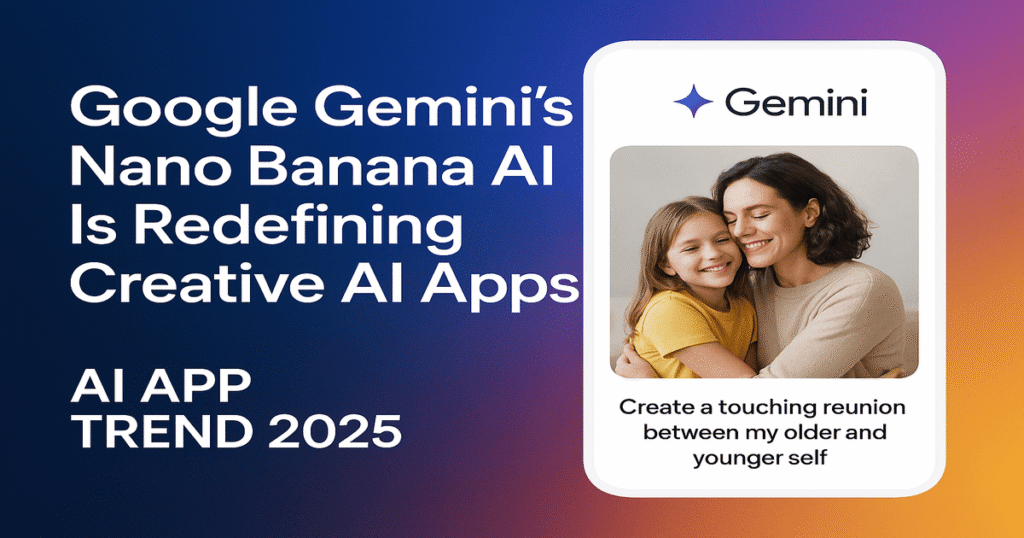
It has been observed that new AI tools often gain attention through technical innovation. However, Gemini’s viral success was achieved not through complexity, but through emotional connection. The Nano Banana feature sparked the “Hug My Younger Self” trend — a challenge in which users generate AI images of themselves comforting their younger versions.
This emotional, share-friendly use case rapidly spread across TikTok, Instagram, and X (formerly Twitter). Millions of users posted their creations, turning Gemini from a productivity tool into a global creative movement. According to India Times, the feature helped Gemini dethrone ChatGPT as the most downloaded AI app in multiple countries, reaching over 23 million new installs in just a few weeks.
As a result, search traffic for “Google Gemini app”, “Nano Banana AI”, and “Gemini vs ChatGPT” surged dramatically. The app now dominates Google Trends for AI-related software queries, suggesting that interest in generative creativity is outpacing purely conversational tools.
From Chatbots to Creative Companions
In earlier years, conversational AIs such as ChatGPT focused on generating text, code, and structured replies. Gemini, on the other hand, emphasizes multimodality — combining text, image, and voice inputs to create expressive outputs.
This shift from chatbot to creative companion is redefining the app market. Users are no longer satisfied with text-based AI responses; they seek visual expression, artistic control, and social shareability. Gemini’s new feature leverages this desire by making advanced AI editing accessible to anyone, without professional design skills.
Because users can simply type prompts like “make this photo look like a memory from 1998” or “turn me into a comic-book hero”, creative AI has moved from niche software into everyday use. Consequently, app developers worldwide are studying Gemini’s design choices as a case study in viral product strategy.
The Technology Behind Nano Banana
While Google has not released full technical documentation, several aspects of Nano Banana can be inferred from the company’s broader AI ecosystem.
It appears that the feature relies on Gemini 2’s multimodal foundation model, which integrates image synthesis and contextual understanding. Instead of merely editing a single visual attribute, it interprets emotional tone, facial consistency, and scene realism simultaneously. This fusion results in lifelike, emotionally resonant images — a major leap from previous AI editors.
The name Nano Banana itself may sound playful, but it reflects the system’s internal codename for micro-adjustment layers (“nano” operations) combined with tone-mapping filters (“banana” being internal Google humor). Regardless of its origin, the feature’s performance has demonstrated that emotional storytelling can fuel exponential adoption of AI apps.
User Behavior & Market Impact
Because Gemini’s viral trend was amplified by emotional storytelling, its market performance has mirrored that of viral social platforms rather than traditional software.
- Search Volume: Google Trends data show that “Google Gemini app” has experienced a 900% increase in global search interest since August 2025.
- Engagement Rate: The average session length reportedly doubled compared to text-based AI tools, as users spend more time refining creative prompts.
- App-Store Rankings: Gemini has maintained top positions across multiple regions, temporarily overtaking ChatGPT, Bing AI, and Copilot in downloads.
- Monetization: Premium features tied to HD image output and batch editing have driven a substantial rise in in-app purchases.
Because of these outcomes, other tech giants and startups alike are racing to develop emotion-driven AI experiences — systems designed not only to inform but also to connect on a personal level.
Lessons for Developers and Digital Creators
For developers, the rapid rise of Google Gemini underscores several critical lessons:
- Emotion Drives Virality. The “Hug My Younger Self” trend proved that emotional resonance can outperform even the most advanced technical feature in attracting attention.
- Accessibility Wins. By making complex image generation as simple as a chat prompt, Gemini lowered the barrier for non-technical users.
- Cross-Platform Integration Matters. Features that can be easily shared on social media platforms are more likely to gain traction.
- Continuous Updates Retain Interest. Frequent updates and challenges keep the app relevant in fast-moving markets.
Because these strategies have been validated by Gemini’s success, future AI app builders are expected to focus on creative utility, social virality, and user inclusivity rather than raw model size.
Example: Conceptual API Integration
Below is a simplified Python example showing how an AI-image editing function might be implemented conceptually. Although this snippet is illustrative and not tied to any proprietary Google API, it demonstrates how a creative-AI feature could be embedded in future productivity or design apps.
|
1 2 3 4 5 6 7 8 9 10 11 12 13 14 15 16 17 18 19 20 21 22 23 24 25 26 27 28 29 30 31 |
# Conceptual example: AI-based image editing integration import requests API_URL = “https://api.gemini.ai/v1/image/edit” API_KEY = “YOUR_API_KEY” def generate_emotive_edit(image_path: str, prompt: str) -> bytes: “””Send an image and prompt to a creative AI API.””” with open(image_path, “rb”) as file: image_data = file.read() payload = { “prompt”: prompt, “image”: image_data, “options”: {“emotion_enhance”: True, “style”: “photo_realistic”} } headers = {“Authorization”: f“Bearer {API_KEY}”, “Content-Type”: “application/json”} response = requests.post(API_URL, json=payload, headers=headers) response.raise_for_status() return response.content # Example usage if __name__ == “__main__”: edited_image = generate_emotive_edit( “child_photo.jpg”, “Create a touching reunion between my older and younger self.” ) with open(“result.jpg”, “wb”) as output: output.write(edited_image) print(“AI edit completed successfully.”) |
This form of integration could be expanded to support filters, batch edits, or workflow automation. Because such features are increasingly expected by users, developers who include creative-AI APIs in their products will remain competitive.
Competitive Landscape: Gemini vs ChatGPT
It is impossible to discuss Gemini’s ascent without mentioning its primary competitor — ChatGPT. Although both belong to the same family of generative AI systems, their focus diverges. ChatGPT excels in linguistic reasoning, problem solving, and automation, while Gemini emphasizes visual and contextual creativity.
As AI ecosystems evolve, it is likely that users will switch between both tools depending on task requirements. For instance, one might use ChatGPT to write an article outline, and Gemini to design its accompanying illustration.
From a market-analysis perspective, this complementary relationship is expected to continue. Both systems reinforce each other’s growth by expanding public understanding and acceptance of AI tools.
Ethical and Social Considerations
With every technological breakthrough comes responsibility. The widespread use of AI-generated images raises valid questions:
- How can users ensure authenticity in an era of photorealistic AI visuals?
- Should platforms label AI-generated content to prevent misinformation?
- What safeguards must be built to protect personal likenesses from misuse?
Because Google has publicly committed to watermarking and metadata labeling in AI images, Gemini’s success may encourage industry-wide standards. Nonetheless, continuous vigilance will be required as creative AI becomes more powerful and accessible.
The Future of Creative AI Apps
The trajectory of Google Gemini suggests that creative expression will be the next frontier of AI adoption. Rather than replacing artists or designers, AI tools like Gemini appear to be empowering users to experiment and tell stories.
This democratization of creativity is reshaping not only consumer behavior but also the app-development landscape. It is likely that within the next year:
- AI image-editing capabilities will be embedded in most social and productivity apps.
- Users will expect multimodal responses (text + image + voice) by default.
- New APIs will emerge to simplify cross-platform sharing and monetization.
Because these trends align with broader market shifts toward personalization and interactivity, creative AI will remain at the center of digital transformation in 2026 and beyond.
Key Takeaways
✅ Emotional design drives engagement. Users connect more with features that evoke feelings.
✅ Simplicity equals adoption. The easier it is to use an AI tool, the faster it spreads.
✅ Social virality fuels growth. Integration with shareable content multiplies reach.
✅ Visual AI is the next big wave. Text-only chatbots are giving way to creative, multimodal systems.
✅ Developers should prepare. Building compatible or complementary tools will open new markets.
Frequently Asked Questions
Because of its Nano Banana feature, which allows emotionally rich AI image editing and has gone viral on social media.
It uses Gemini’s multimodal AI model to modify images based on emotional and stylistic prompts, producing realistic and expressive results.
Yes. By using available AI-image APIs or upcoming Gemini integrations, developers can embed creative features in their own apps.
ChatGPT focuses on text generation and logic, while Gemini emphasizes visual creativity and multimodal interaction.
Unlikely. Instead, it will complement artistic workflows by accelerating ideation and experimentation.
Conclusion
The rise of Google Gemini and its Nano Banana feature marks a pivotal moment for the app industry. Because emotional storytelling has merged with technical innovation, creative AI is no longer a niche — it has become a mainstream expectation.
Developers, marketers, and users alike are being influenced by this evolution. And as more platforms adopt multimodal AI, the boundaries between imagination and technology will continue to blur.





Leave a Reply